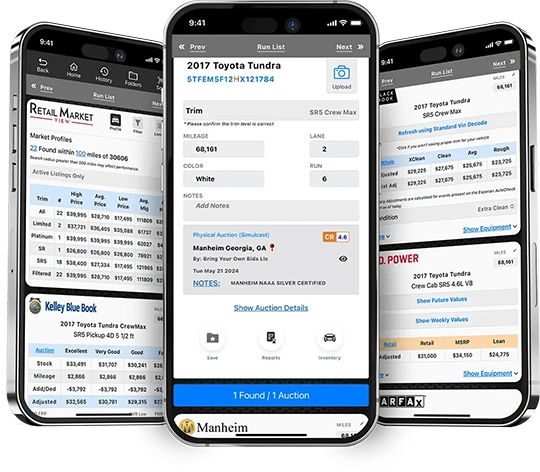
Automotive VINs can appear in several different barcode formats—on auction run lists,
window stickers, titles, registration forms, and in your own documents.
Laser Appraiser VIN Scanner reads them all so your team never slows down.
Laser Appraiser VIN Scanner is tuned to decode the common VIN barcode symbologies
dealers, wholesalers, and auctions rely on every day. Use this guide to quickly compare
each type and drill down into the details.
Code 39 VIN Barcodes
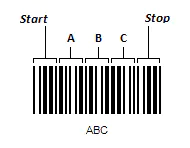
Code 39 is the original one-dimensional VIN barcode used widely
on vehicle labels, titles, and older documents. It encodes letters
and numbers in a simple, easy-to-scan format.
Classic VIN barcode used for decades in automotive workflows;
Flexible length and tolerant of print quality variations;
Ideal for legacy labels, registration paperwork, and service files.
Code 128 is a high-density 1D barcode that packs more data into less space.
Auction houses commonly use Code 128 to represent VINs on run lists and
logistics labels.
Great for crowded auction paperwork and logistics labels;
Encodes full ASCII for flexible data formats;
Widely adopted in shipping, warehousing, and auctions.
PDF417 is a stacked, high-capacity barcode used on many government labels,
including titles and registration documents. It is ideal for storing
lots of data in a compact, secure symbol.
Popular on state and federal vehicle paperwork in the US;
Stores VIN plus additional registration or owner data;
Designed for strong error correction and reliability.
Data Matrix is a 2D code that fits a lot of information into a very small area,
making it perfect for etched or printed marks on components and VIN plates.
Some manufacturers use Data Matrix for VIN markings.
High-density 2D barcode for tight spaces and metal marking;
Designed to stay readable even when partially damaged;
Used by manufacturers and parts suppliers across industries.
QR Codes are familiar to consumers and widely used for marketing, window
stickers, and mobile experiences. Some OEMs use VIN-based QR Codes to link
shoppers directly to vehicle information online.
Instant bridge from physical vehicles to digital experiences;
Easy for customers to scan with any smartphone;
Supports VIN-driven landing pages, spec sheets, and offers.